
A practical architecture guide for protecting vessel IT, OT, and maritime services with application delivery, segmentation, and cybersecurity governance
Modern vessels increasingly depend on interconnected systems: navigation, automation, propulsion monitoring, cargo operations, crew services, and shore-based management. This connectivity improves efficiency, but it also creates a larger attack surface and makes the separation between IT, OT, and safety-critical systems essential.
VMware Avi, now part of VMware Avi Load Balancer, can contribute to this environment by providing application delivery, load balancing, health monitoring, and application-layer traffic controls. However, it is important to position Avi correctly: it is an application delivery and security component—not a replacement for OT firewalls, industrial segmentation, or vessel safety controls.
This article explains how to integrate Avi into a Purdue Model architecture, map its capabilities to the NIST Cybersecurity Framework, and apply the design to a marine environment without introducing unnecessary risk to operational technology.

Why This Matters in Maritime Cybersecurity
A vessel is not simply a floating data center. It is a cyber-physical environment where a disruption to an application can affect cargo operations, maintenance, communications, or—if poorly designed—operational safety.
A useful architecture must therefore answer three questions:
-
Where does the application belong in the Purdue Model?
-
Which NIST cybersecurity outcome does each control support?
-
How can security be improved without creating a new dependency or attack path into critical OT systems?
The Purdue Model provides a way to organize industrial systems by operational function and trust boundary. NIST CSF 2.0 provides a risk-management structure built around six functions: Govern, Identify, Protect, Detect, Respond, and Recover. NIST describes CSF 2.0 as a taxonomy of cybersecurity outcomes rather than a prescriptive list of technologies.
1. Understanding VMware Avi in a Marine Environment
VMware Avi Load Balancer is a software-defined application delivery platform. Its capabilities include load balancing, application health monitoring, TLS termination, application analytics, and—depending on the deployed edition and configuration—security capabilities such as WAF, rate limiting, and DDoS protection.
In a vessel or maritime data-center environment, Avi can be used to protect and distribute traffic for applications such as:
-
Crew welfare and intranet portals
-
Maintenance and condition-monitoring dashboards
-
Cargo and logistics applications
-
Fleet management portals
-
Ship-to-shore reporting services
-
Vendor access portals
-
Maritime analytics and API services
-
Replicated applications hosted across vessel and shore infrastructure
What Avi should not do
Avi should not become a direct control path to:
-
Main engine PLCs
-
Propulsion control systems
-
Navigation control systems
-
Safety instrumented systems
-
Cargo-control PLCs
-
Critical field devices
These systems require their own approved industrial security architecture, access controls, and operational procedures. Avi can protect applications that consume OT data, but it should not be used as a substitute for an OT firewall, safety boundary, or industrial protocol security gateway.
2. Purdue Model Mapping for Marine Operations
The following mapping adapts the Purdue Model to a vessel and its shore-connected environment. Exact layer assignments may vary by vessel design and vendor architecture.

Layer-by-layer integration
|
Purdue layer |
Marine examples |
Avi integration |
|---|---|---|
|
Level 5 |
Fleet management, shore cloud, ERP, corporate identity |
Load balance shore applications, protect external portals, provide TLS and application analytics |
|
Level 4 |
Vessel IT, crew services, maintenance applications |
Primary placement for internal application delivery and secure application access |
|
Level 3.5 |
Industrial DMZ, jump servers, file transfer, historian replication |
Optional placement for approved DMZ applications; enforce application boundaries |
|
Level 3 |
HMI, SCADA, historian, engineering workstations |
Usually consume protected services through approved interfaces; avoid direct Avi dependency for control functions |
|
Levels 0–2 |
Sensors, actuators, PLCs, propulsion, navigation, safety |
No direct Avi insertion into control loops; preserve deterministic operation and approved OT controls |
Design principle: Avi should sit beside the Purdue security architecture, not replace it.
3. Reference Architecture: Vessel-to-Shore
The following reference design separates application delivery from control-system traffic.
Recommended traffic flows
Example 1: Fleet maintenance dashboard

The application can present maintenance information without exposing the engineer directly to the PLC network.
Example 2: Vendor remote support

Avi may protect the vendor-facing application, but remote access authorization, session control, and OT access policy remain separate responsibilities.
4. Avi Components and Their Roles
Avi commonly uses a Controller for centralized management and Service Engines to process application traffic. The platform supports centralized policy management, analytics, and application delivery across supported environments.
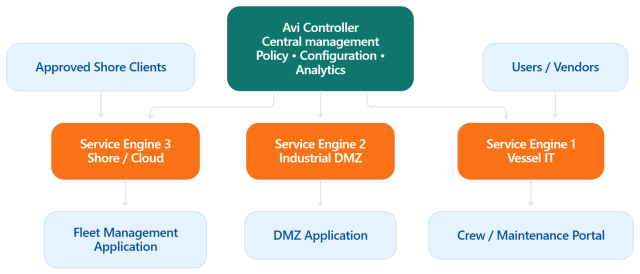
Component responsibilities
|
Component |
Purpose |
Marine design consideration |
|---|---|---|
|
Avi Controller |
Central configuration, policy, analytics |
Place in a secured management zone; restrict administrative access |
|
Avi Service Engines |
Application traffic processing |
Deploy only in approved IT/DMZ segments; avoid direct control-network placement |
|
Virtual Services |
Front-end application endpoints |
Use dedicated IPs, DNS names, certificates, and access policies |
|
WAF / application security |
Inspect and control supported web/API traffic |
Apply to web applications, not raw PLC protocols |
|
Health monitors |
Check application availability |
Use non-invasive application checks; avoid polling that can affect OT systems |
|
Analytics / logs |
Visibility into application traffic and performance |
Forward relevant events to centralized monitoring or SIEM |
5. Mapping Avi to NIST CSF 2.0
NIST CSF 2.0 contains six core functions. The mapping below describes how Avi can contribute to those outcomes; it does not imply that Avi alone satisfies a function or control requirement.
|
NIST function |
Objective in a marine environment |
How Avi contributes |
Additional controls required |
|---|---|---|---|
|
Govern |
Establish cybersecurity ownership, risk tolerance, and maritime security policies |
Provides policy and administrative controls for application delivery |
Governance, asset ownership, risk assessment, supplier management, safety management |
|
Identify |
Discover vessel applications, dependencies, and data flows |
Application inventory, service visibility, traffic analytics |
OT asset inventory, network diagrams, data classification, dependency mapping |
|
Protect |
Prevent unauthorized access and reduce application attack surface |
TLS termination, WAF, access policies, rate limiting, application segmentation |
Firewalls, MFA, PAM, network segmentation, secure configuration, patching |
|
Detect |
Identify suspicious traffic and service anomalies |
Application analytics, security events, health monitoring |
IDS/IPS, SIEM, endpoint monitoring, OT anomaly detection |
|
Respond |
Contain incidents while maintaining safe operations |
Policy changes, service isolation, traffic blocking, operational visibility |
Incident response plans, bridge procedures, OT incident playbooks, communications |
|
Recover |
Restore services and improve resilience |
Application health checks, failover, service recovery support |
Backups, disaster recovery, alternate communications, tested restoration procedures |
Important distinction
Avi protects the application delivery layer. NIST CSF applies to the entire organization and its technology, people, processes, and supply chain. NIST explicitly states that the CSF does not prescribe a specific technology or implementation method.
6. Detailed NIST Integration Architecture

Example: NIST Protect outcome
Scenario: A vessel maintenance portal is exposed to approved shore users.
Avi controls:
-
TLS termination and certificate management
-
WAF policy for web requests
-
Rate limiting for abusive traffic
-
Application access restrictions
-
Health monitoring
-
Centralized application policy
Other required controls:
-
Identity provider and MFA
-
Firewall rules
-
Secure remote-access gateway
-
Role-based authorization
-
Vulnerability management
-
Logging and incident response
The resulting protection is layered rather than dependent on a single product.
7. Marine Industry Use Cases
Use Case A: Vessel Maintenance and Condition Monitoring
Problem: Maintenance teams need access to application dashboards, but the underlying OT systems should remain isolated.
Architecture:

Security benefit: The engineer interacts with a controlled application rather than directly accessing the control network.
Operational benefit: Multiple users can access a highly available application without placing additional traffic directly on the OT network.
Use Case B: Crew Portal and Vessel IT Services
Avi can distribute traffic for:
-
Crew welfare portals
-
Internal announcements
-
Training applications
-
Document management
-
Maintenance requests
- HR and payroll interfaces

Design note: Crew and guest networks should remain separated from operational systems. Avi does not replace that segmentation.
Use Case C: Fleet Management and Shore Analytics
For shipping companies operating multiple vessels, Avi can provide consistent application delivery for fleet services hosted on shore or in a private cloud.

Security benefit: Centralized application policies and visibility can be applied to shore-hosted services.
Availability benefit: Load balancing and health monitoring can help maintain access when application instances fail.
Caution: Vessel-to-shore connectivity may be intermittent or bandwidth-constrained. The application architecture must support offline operation, local caching, and controlled synchronization where required.
8. Recommended Security Zones
A practical deployment should separate the management plane, data plane, and application backends.

Key design rules
-
Separate Avi management from application traffic.
-
Use dedicated administrative identities and least privilege.
-
Restrict Controller access to authorized management networks.
-
Place Service Engines only where application traffic is expected.
-
Use firewalls between IT, DMZ, and OT zones.
-
Do not route arbitrary IT traffic through OT networks.
-
Keep safety-critical control systems independent of Avi availability.
-
Forward security-relevant logs to centralized monitoring.
VMware’s Avi design guidance recommends dedicated accounts, role-based access, and least privilege for Controller administration and integrations.
9. Implementation Roadmap
Phase 1 — Govern and Identify
-
Define the vessel and shore cybersecurity scope.
-
Identify business-critical and safety-critical applications.
-
Document Purdue layers and trust boundaries.
-
Record application dependencies and data flows.
-
Identify owners for Avi, network security, OT, and vessel operations.
-
Define acceptable downtime and recovery objectives.
Deliverable: Approved application and network architecture.
Phase 2 — Protect
-
Deploy Avi in a dedicated management and application zone.
-
Configure secure administration and role-based access.
-
Create virtual services for selected applications.
-
Configure TLS certificates and approved access policies.
-
Apply WAF policies to supported web applications.
-
Integrate Avi with firewalls and identity services.
-
Validate that no new route to critical OT systems is introduced.
Deliverable: Controlled application delivery with documented security policies.
Phase 3 — Detect
-
Enable application analytics and health monitoring.
-
Forward relevant logs to the SIEM.
-
Establish alerts for abnormal application behavior.
-
Monitor failed authentication, policy violations, and service degradation.
-
Correlate application events with firewall and OT monitoring data.
Deliverable: A baseline of normal application behavior and an alerting process.
Phase 4 — Respond
-
Define procedures for blocking malicious application traffic.
-
Create a process for isolating compromised application instances.
-
Coordinate Avi changes with vessel operations and shore security teams.
-
Ensure emergency procedures do not depend on the availability of the application layer.
-
Test incident escalation and communications.
Deliverable: An incident response playbook covering Avi and adjacent systems.
Phase 5 — Recover
-
Test application failover and service restoration.
-
Maintain configuration backups.
-
Document recovery dependencies.
-
Validate that OT operations remain safe if Avi or the application is unavailable.
-
Review lessons learned and update the architecture.
Deliverable: Tested recovery procedures and an updated risk register.
10. Example Security Policy Matrix
|
Traffic flow |
Allowed? |
Recommended control |
|---|---|---|
|
Shore user → Fleet application |
Yes |
HTTPS, Avi virtual service, WAF, identity, rate limiting |
|
Crew device → Crew portal |
Yes |
IT firewall, network segmentation, Avi application policy |
|
Vendor → Industrial DMZ jump server |
Controlled |
MFA, approved remote access, firewall rules, session logging |
|
Maintenance application → Historian replica |
Controlled |
Allowlisted API or approved data protocol |
|
Historian replica → PLC network |
Highly restricted |
OT firewall, approved one-way or tightly controlled flow |
|
Avi Service Engine → Main engine PLC |
No direct dependency |
Preserve independent OT control architecture |
|
Guest Wi-Fi → OT network |
No |
Network isolation and firewall enforcement |
|
Avi Controller → OT control network |
No direct management path |
Dedicated management network and approved integration boundaries |
11. Operational and Safety Considerations
Avoid creating a single point of failure
Avi can improve application availability, but the vessel must remain operational if Avi fails. Critical control and safety functions should not require:
-
An Avi Controller
-
An Avi Service Engine
-
A shore application
-
A cloud identity service
-
A ship-to-shore link
Use passive or low-impact validation for OT
When integrating or testing the architecture:
-
Prefer configuration review and traffic observation.
-
Use approved maintenance windows.
-
Validate application health checks against test or replicated services.
-
Avoid aggressive scans or malformed traffic against PLCs.
-
Do not introduce WAF or load-balancing policies into deterministic control paths.
-
Test failover without interrupting propulsion, navigation, or safety systems.
Consider maritime connectivity constraints
Satellite links and vessel-to-shore networks may have:
-
High latency
-
Limited bandwidth
-
Intermittent connectivity
-
Expensive data transfer
-
Strict operational availability requirements
Application design should account for these conditions through local services, caching, asynchronous synchronization, and graceful degradation.
12. Measuring Success
Avi integration should be evaluated using both cybersecurity and operational measures.
|
Area |
Example metrics |
|---|---|
|
Govern |
% of applications with assigned owners and approved risk assessments |
|
Identify |
% of application dependencies documented; unknown services discovered |
|
Protect |
TLS coverage, WAF policy coverage, unauthorized access attempts blocked |
|
Detect |
Mean time to detect application anomalies; log coverage |
|
Respond |
Time to isolate a compromised application; incident playbook completion |
|
Recover |
Application recovery time; successful failover tests |
|
Marine operations |
No unplanned impact to OT systems; vessel application availability; shore-link resilience |
These metrics should be interpreted in the context of vessel operations and safety requirements—not only IT performance.
13. Common Mistakes to Avoid

Conclusion
Integrating VMware Avi into a marine cybersecurity architecture is most effective when it is treated as an application delivery and security layer within a larger defense-in-depth design.
The Purdue Model helps define where systems belong and how they should be separated. NIST CSF 2.0 helps define what cybersecurity outcomes the organization needs to achieve. Avi contributes to those outcomes through application visibility, secure traffic handling, availability, and application-layer protection.
The resulting architecture should follow this principle:
Protect maritime applications aggressively, but protect operational control systems conservatively.
A well-designed deployment improves application resilience and visibility while preserving the independence, segmentation, and safety requirements of vessel OT.
Reference Architecture Summary

Author’s note: This is a reference architecture for design and planning. Actual vessel deployments should be validated against the vessel’s approved network diagrams, equipment vendor requirements, flag-state obligations, company security policies, and operational safety procedures.
Further reading
-
VMware Avi design guidance — vSphere design guide and best practices